
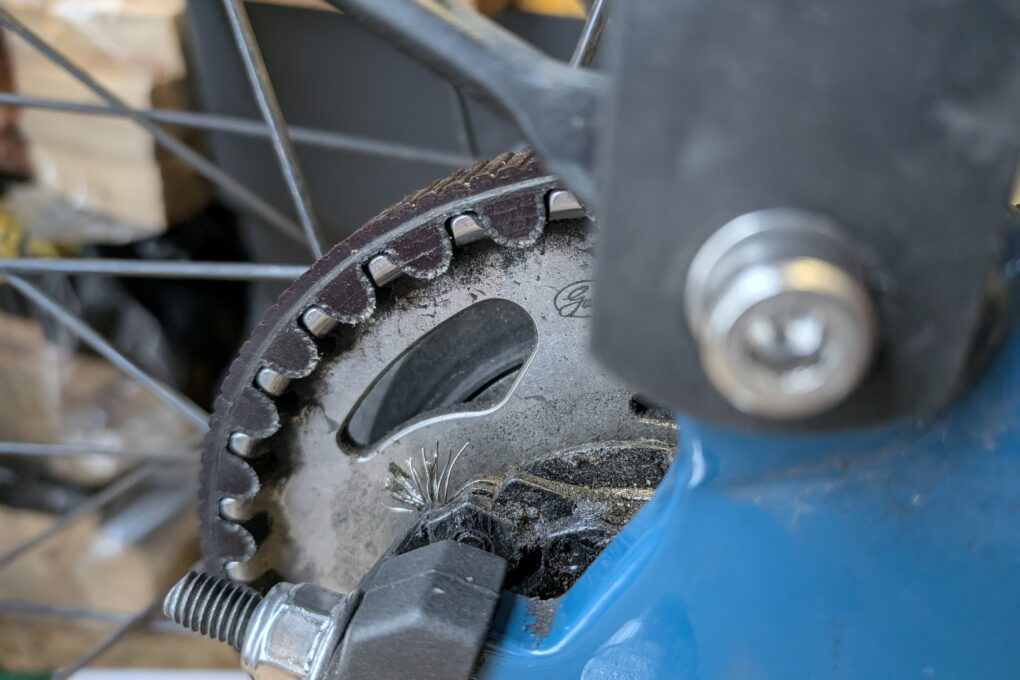
One of the great things about my electric bicycle is that is uses a belt drive instead of a chain.
Carbon belts have numerous advantages over chains, such as being quiet, clean and virtually maintenance free. They don’t rust, they don’t require lubrication, they don’t stretch over time, and typically last a lot longer than chains – somewhere in the range of 15-30,000 kms – 3-4 times longer than a chain.
Of course, for every rule there is an exception, and my belt snapped last week after only 3,250 kms use – when I was 5 kms away from home on a wet and windy night. I had to lock up my bike and take a taxi home, as there’s no way to fix a belt by the side of the road. It has to be replaced.
Of course, belt drives aren’t yet that common. A few brands have them on some ebikes and commuter bikes – but the vast majority of bikes still use chains. And so, when I approached a few local bike shops to try and get a new chain, they told me they don’t stock them, and don’t even know where to order them from – probably because they hardly ever need replacing.
Thankfully, my carbon belt was still within warranty, so through my ever helpful dealer (shout out to Howard at BBikes) I was able to request a replacement. However it would take over a week to be shipped to Ireland from The Netherlands.
Sizing the new belt
The carbon belt is one loop of carbon fibre and nylon. It’s not like a chain, where you can remove individual links with a tool. And so it’s really important to order the correct size. There are loads of different lengths (and widths I think) of belts that are often sized based on the number of teeth on the belt.
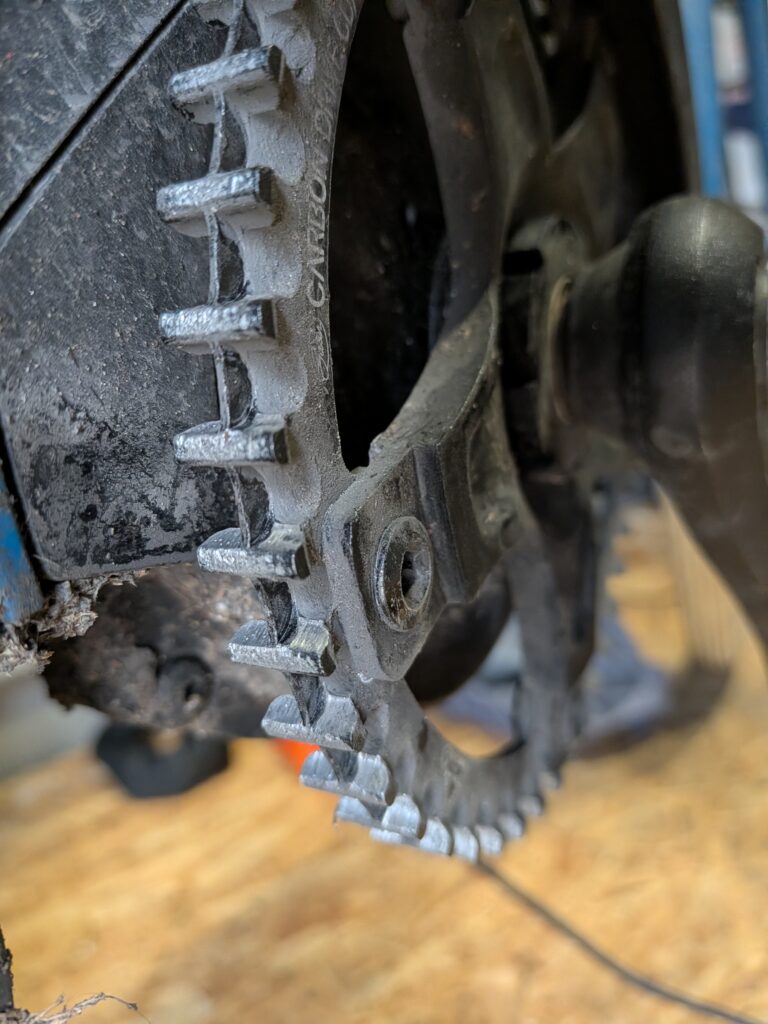
Mine needed to be a Gates Carbon Drive CDX belt centretrack – 12mm pitch, 11mm width, 128 teeth (1404mm length)
Gates is the manufacturer. CDX is the shape of the teeth on the belt to match the holes on the sprockets. Pitch is the size of the teeth. And most importantly, the belt length needs to be exactly 128 teeth to fit with the dimensions on the bike frame. Belt drives typically don’t have tensioners to keep the belt tight. The belt tension is achieved by moving the rear wheel backwards or forward on the frame.
Fitting the new belt
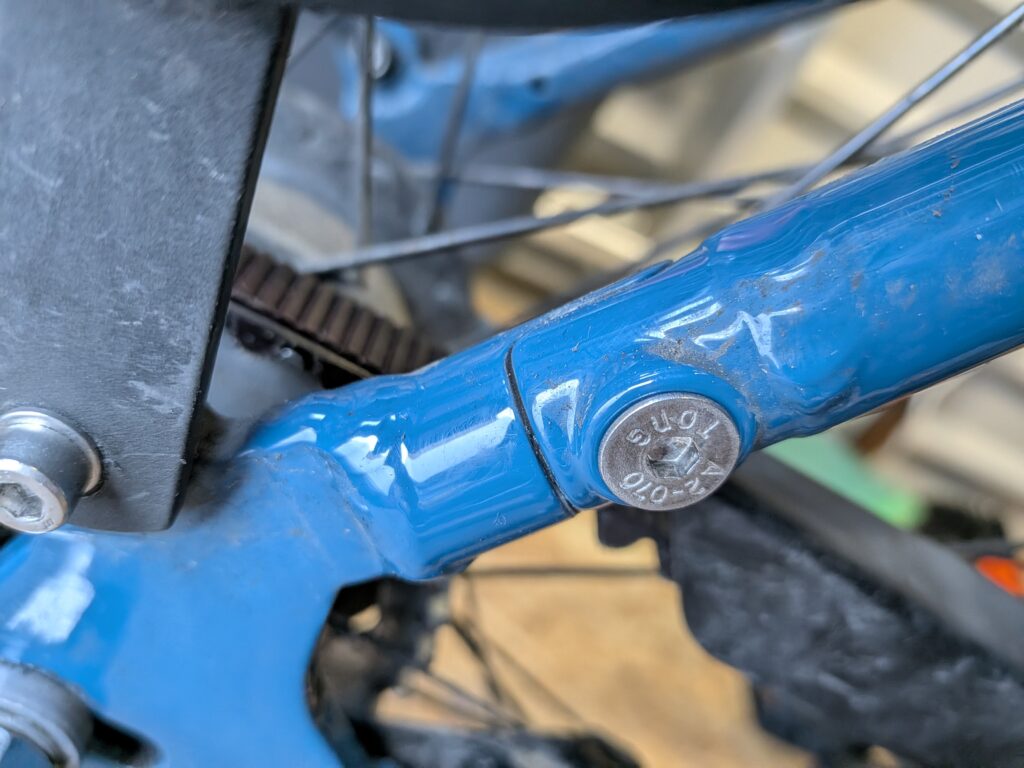
If you look at the geometry of a bike frame, you can see that the belt (or chain) is often inside the bike frame at the wheel, and outside the frame at the pedals. With a chain, someone can take it apart and thread it through where it needs to go. But with a belt, it doesn’t come apart. The only way to fit it is for the bicycle frame itself to come apart – which is why a special bike frame is required for belt drives. My bicycle has a bolt on the rear triangle that allows the frame to separate enough to feed a new belt through.
I also had to take the back wheel off, which is a pain to do at any time. It involves undoing loads of bolts, deflating the tyres to get past the brake pads, detaching the hub gears mechanism – and then the wheel can become free and allow a new belt to be fitted.
I also find that when my back wheel moves even a tiny amount, I need to spend an inordinate amount of time afterwards adjusting the brakes so that they don’t rub on the wheel but still get enough grip to stop.
I’m no expert bike mechanic. I know just enough to get me through a repair, eventually. And this repair took me about 60 minutes to complete. Probably about half of that was adjusting the brakes – as I never quite seem to get the wheel back on at the same position as when it came off.
I’m glad that, after a week of using the bus, my bike is back in action. I use it probably about 5-6 days of the week, and it’s my main form of transport to get around Dublin. It takes only 20-25 minutes to cycle into the city centre, but to drive is 30-40 minutes, and the bus is anything up to an hour.
When I first wrote this article, I thought I was done fixing the drive train and the back wheel. I was wrong. My mention about the inordinate amount of time adjusting the back wheel and brakes ended up spanning days rather than hours.
Twice I was convinced everything was fine setting off from home, only to find they either the hub gears were stuck in the lowest gear or the wheel was rubbing against the brakes or frame. I was not a happy bunny.
Luckily after several goes the wheel is in alignment, the brakes work, the gears work, and belt is turning the wheel. So it’s all good for the moment. That is, until something else on the bike fails!